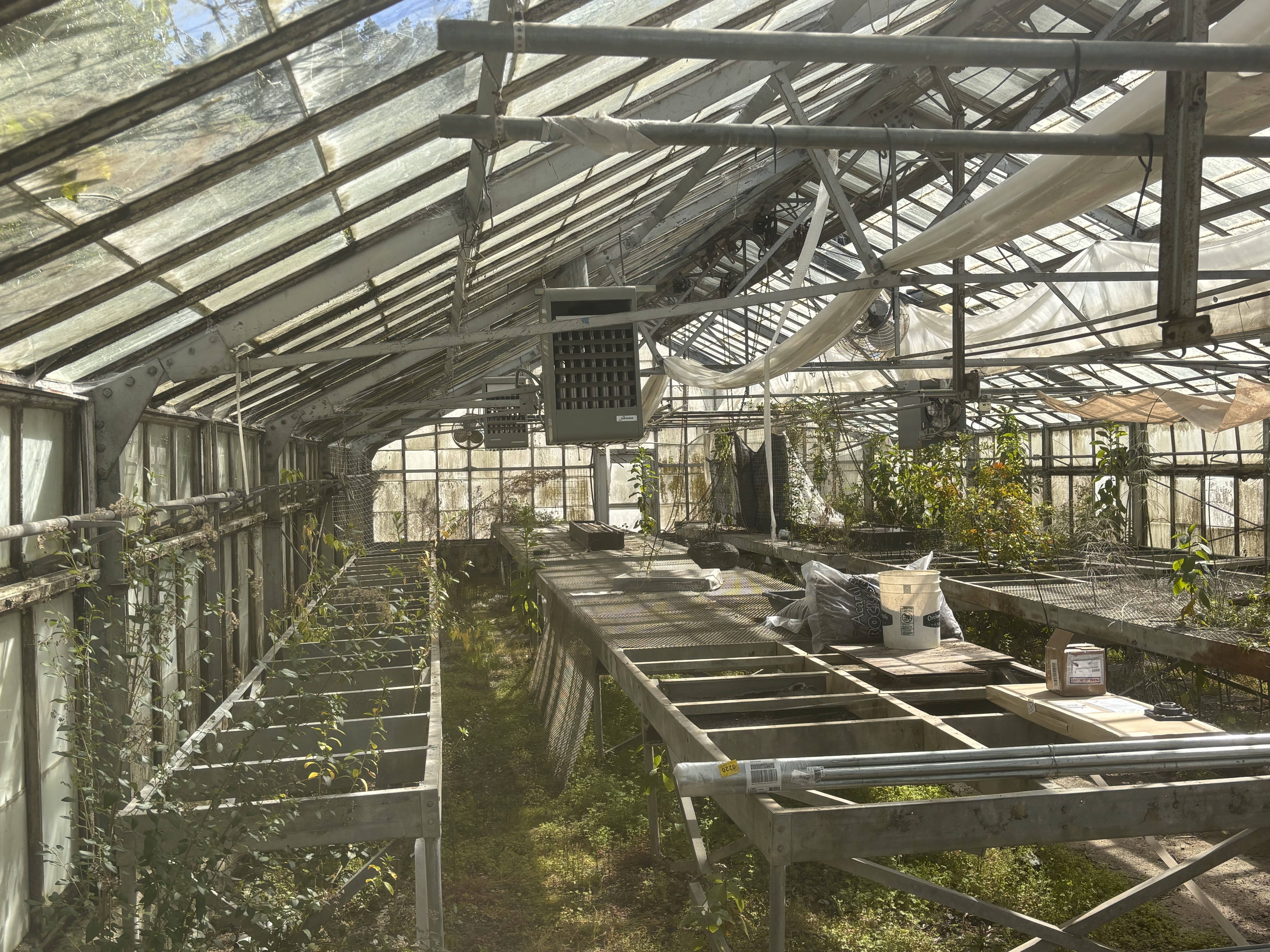
In the Southeast corner of San Francisco, tucked between two intersecting freeways and a 300-acre public park, lies an entire city block that is home to over a dozen abandoned greenhouses. On a sunny day, the remains of their glass roofs sparkle, displaying a patchwork-like mosaic created over many years as panes have broken or fallen out. Up close, the dilapidated roofs are just one sign of the lot’s visible neglect: they are joined by rusted pipes from the remnants of an irrigation system and splintered wooden frames sagging into tall grass that blankets the ground. At first glance, the unassuming greenhouses may not seem to be very significant to Bay Area environmentalism, but they represent a long history of agriculture, community organization, and urban greening within the Portola neighborhood.
San Francisco’s weather is largely characterized by its abundance of fog, but certain areas of the city, shielded from the marine layer by rolling hills, experience the same Mediterranean climate and high humidity as the rest of the city without the shortage of sunshine. As immigration to the Bay Area increased in the late-nineteenth and earlytwentieth centuries, the Portola’s good weather made it a prime location for settlement in the form of farms and homesteads. By the 1920s, the many blocks of agricultural land in the neighborhood grew produce, but more notably, also grew the majority of San Francisco’s flowers in greenhouses. Although most of the Portola’s agricultural lots and flower nurseries were sold and converted into housing developments by the 1960s, one lot owned and operated by the Garibaldi family continued to grow and sell roses until 1990 in the greenhouses that are left today at 770 Woolsey Street.
The greenhouse ruins are the last physical remnants of the Portola’s early immigrant communities and their agricultural achievements, making their preservation a primary concern for community members, urban gardening enthusiasts, and conservation groups alike. Since the early 2000s, many organizations have taken on the mission to restore the abandoned greenhouses with the specific goal of turning the property into an urban farm for community use. “This is the last remaining evidence of that history of those immigrants who came to the city 100+ years ago, and a good way to honor that is to carry on farming in that place where they were,” says Elisa Laird, founder of the organization Friends of 770 Woolsey. So far, the fight to restore the greenhouses has failed to get past a critical early step: acquiring the lot. After the land was purchased by a developer in the 2010s, Friends of 770 Woolsey, working with The Greenhouse Project, mobilized members of the community to oppose plans to turn the block into a new condo development. “Every time they needed to go to get approval for something with the planning department at City Hall, large numbers of neighbors would show up and tell City Hall why they felt like the property was better used as a farm than as condos,” Laird explains.
After months of community resistance and advocacy, the conflict between the developers and the neighborhood came to a head in late 2019, when then-supervisor Hilary Ronen brought both sides together to mediate negotiations on a resolution for the property. The resulting plan, developed around the beginning of the pandemic, was that The Greenhouse Project would formally raise funding to buy the property and would be given an 18-month timeline to do so. If they failed to raise sufficient funds, the community would stop resisting all of the developers’ plans, but the developers would be required to allocate a corner of the block for restoration and community use.
The contentious fight for the greenhouses’ preservation was far from the only urban greening initiative in the neighborhood at the time. Beginning in 2007, the Portola Garden Tour was created as a fundraising strategy for the neighborhood’s new library building, and tickets were sold that provided attendees with admission to some of the most beautiful gardens in the area, many of which were in residents’ backyards. After the library was built in 2009, money from the tour started going to a scholarship program for green work projects within the Portola that employed horticulture and floristry students from the City College of San Francisco.
Due to the fact that the Portola was split up between three supervisorial districts until 2010, and perhaps in part due to the isolating effect that being between two large freeways has on a neighborhood, the Portola’s history of urban agriculture has not always received the most attention or recognition. One notable exception to this occurred in 2016, when San Francisco’s Board of Supervisors passed a resolution to formally recognize the Portola as the city’s “Garden District” and confirm support for the neighborhood’s Green Plan, citing the pride that neighbors felt for their district and highlighting their accomplishments in furthering sustainability and environmental resilience within the community, with particular emphasis on the ten years of growing awareness fueled by the Portola Garden Tour.
Today, successful urban greening projects within the Portola include the development of a garden on Goettingen Hill, the Alemany Island Beautification Project, and the creation of Burrows Pocket Park. Motivated by the success of these projects, the Portola Green Plan was developed to consolidate multiple community goals into one overarching strategy for reclaiming the Garden District’s history. One project that was embraced after the city’s approval of the Portola Green Plan was the development of a “greenway”, which would utilize the Caltrans easement on the side of the 101 freeway for the purpose of developing a garden.Since 2016, members of the Portola Neighborhood Association’s Garden Club have shown up on the first Saturday of each month at any one of the numerous gardening sites, ready to pull weeds, move wheelbarrows, and enjoy each other’s company. During the pandemic, work in the gardens increased as previously uninvolved residents found themselves with an abundance of free time and a desire to get outside.
As public interest in the Portola’s green spaces grew, so too did the funding for The Greenhouse Project’s intended purchase of the lot at 770 Woolsey Street. When their deadline approached in 2022, the organization had raised 15 million dollars, which was enough to cover the previously estimated property value of around 13 million, as well as fees that the developers had incurred over the years. When the group approached the developers with the money, they were told that the number had changed and that the developers were no longer able to sell at the previously agreed upon price. Having already rallied their community to raise so much money, The Greenhouse Project attempted to continue negotiations, but the deadline was looming, and the pleas to lower the price of the lot were in vain. Ultimately, The Greenhouse Project was blocked from buying the greenhouses, and financial pledges were returned to the organizations and donors who had contributed. Maggie Weis, one of the co-directors of the PNA Garden Club, remembers watching the disappointment her neighbors experienced when The Greenhouse Project failed to acquire the property. “I just felt, like, the air go out of them,” she says. “But at any rate, meanwhile, we kept on building the greenway.”
The creation of urban green spaces, like those in the Portola, has become a popular topic for the potential positive impacts that greening has on increasing biodiversity and climate change resilience in cities, as well as generating public interest and involvement in environmental issues. One 2025 study, which was co-authored by UC Berkeley professor Iryna Dronova, found that many biodiversity elements in urban greening were associated with improved mental and physical health, improved childhood development, and less exposure to pollution. As neighborhoods and cities seek to build their own greenways and community gardens, the Portola provides a strong case study of the factors that are most important for success.
One such factor is high levels of engagement from city agencies and officials. When reflecting on the successes of their respective greening projects, Laird and Weis emphasized the importance of the support they had received from former supervisor Hilary Ronen, the SF Department of Public Works, and the Community Challenge grant program. Although very little has changed regarding the greenhouses since Ronen retired, her successor, Jackie Fielder, has shown some interest in carrying on Ronen’s role if the opportunity presents itself. When approached for comment, Fielder’s office stated, “Our city needs devoted, permanent space for urban agriculture, especially as we see skyrocketing grocery prices that continue to climb. We support the community’s long established interest in this historic agricultural site. We will work to ensure that any new project also adheres to the negotiated community benefits that are attached to the project’s entitlements.”
Although The Greenhouse Project was unable to purchase the greenhouses in 2022, theoretically allowing for condo development on the property to begin without opposition, the developers actually quietly put the lot up for sale in early 2025, and the greenhouses remain at 770 Woolsey. On the issue of whether there is still potential for the greenhouses to be restored, Laird says, “the neighborhood would welcome anyone who was interested in coming in and keeping the space as some kind of green space that could be honoring the agricultural history of the Portola, because that’s what the neighborhood was fighting for all this time.” The same barriers remain, and it cannot be overstated how crucial consistent funding is for creating urban green spaces, and how much work has to go into securing that funding–even the greenway project, which has been strongly supported in the past, failed to secure grant funding for this year.
Despite the uncertain futures of their projects, the energy among these organizers remains hopeful and positive, and the core of the Portola’s success is represented in what Weis says about her experience working on the greenway: “Everything’s been kind of fun and interesting, you know. And whoever is on the project, we’re always learning.” Whatever the future holds for the Garden District’s green initiatives, the Portola community members will be at the forefront of any changes, honoring their urban agricultural history and inspiring other communities to do the same.


